How BAB Group of Companies Is Reimagining Business Visibility Through The Furniture Times (TFT), Furniture Industry Search Engine (FISE), FISE LIVE and the FISE Searchology Inclusion System™
By BAB Group of Companies
A business can have exceptional products, talented people, years of experience, competitive prices, and the determination to grow. It can deliver quality, satisfy customers, and solve real problems. Yet, despite everything it has built, it may remain unknown to the people who need exactly what it offers.
This is one of the most overlooked challenges in today’s business environment: the invisible business problem.
Every day, businesses compete for attention. Large brands invest in advertising, professional marketing teams, sophisticated websites, and international campaigns. Meanwhile, thousands of small and medium-sized enterprises, independent manufacturers, artisans, makers, and grassroots creators struggle to get noticed.
Some have outstanding products but limited digital exposure. Others have remarkable craftsmanship but no effective way to reach buyers outside their communities. Many have built their businesses through years of dedication but remain difficult to discover online.
Their problem is not always the quality of their work. Sometimes, it is the absence of visibility.
And this problem carries a serious cost.
When customers cannot find a business, they cannot evaluate its products. When buyers cannot identify potential suppliers, valuable commercial relationships may never begin. When artisans remain invisible, their craftsmanship may receive less recognition than it deserves. When small enterprises lack a clear digital identity, their opportunities to compete can become limited.
Being invisible in a digital economy can mean losing opportunities without even knowing they existed.
This is the challenge BAB Group of Companies seeks to address through a broader vision of business storytelling, digital discovery, and inclusive visibility.
Through The Furniture Times (TFT), Furniture Industry Search Engine (FISE), FISE LIVE, and the FISE Searchology Inclusion System™, the vision is to help businesses become easier to identify, understand, discover, and connect with relevant audiences.
Because the future of business should not be determined solely by who has the biggest advertising budget. It should also create opportunities for those who have something valuable to offer.
The Most Expensive Business Problem Is Sometimes the One You Cannot See
Businesses regularly monitor their expenses, sales figures, production costs, inventory, and customer satisfaction. They identify operational problems and look for ways to improve profitability.
But how many businesses measure the opportunities they lose because potential customers never discover them?
Consider a furniture manufacturer producing high-quality tables, chairs, cabinets, and customized furniture. Its production team understands the materials, its craftsmen know their work, and its products meet customer expectations.
However, its website receives limited attention. Its business information is scattered across different platforms. Its products are not presented clearly, and international buyers have no easy way to understand its capabilities.
Somewhere else, a retailer is searching for a manufacturer with precisely those capabilities.
The two businesses could potentially work together, but they never connect.
Now consider an independent artisan producing handmade furniture or home accessories. The artisan has spent years developing specialized skills, but the business has limited digital reach. Potential customers who appreciate handmade craftsmanship may never encounter the work.
Or consider a small enterprise offering excellent services but relying almost entirely on referrals. When those referrals slow down, the business struggles to generate new enquiries.
These situations reveal an important reality.
A business does not have to be unsuccessful to be invisible. It can be excellent at what it does and still remain undiscovered.
The invisible business problem is particularly challenging because its consequences are not always immediately measurable. A missed opportunity does not appear as an expense on a financial statement. An international buyer who never finds a supplier does not send a rejection email. A customer who chooses a more visible competitor may never explain why.
This makes discoverability an important consideration in business development.
The first step toward solving the problem is recognizing that having a business and being discoverable as a business are two different things.
Why Great Products Do Not Always Translate into Great Sales
One of the biggest misconceptions in entrepreneurship is that a good product will automatically attract customers.
Quality matters. Pricing matters. Customer experience matters. But these factors become relevant only when potential customers have an opportunity to discover and evaluate what a business offers.
Imagine two companies selling similar products.
Company A has a professional digital presence, clear product descriptions, useful photographs, accurate contact details, and consistent business information.
Company B offers equally good products but has incomplete online information, limited product descriptions, and no clear pathway for enquiries.
A prospective buyer searching online may find Company A first, understand its offerings, and initiate contact.
Company B may never enter the buyer’s consideration.
This does not necessarily mean Company A produces better products. It means Company A has made itself easier to understand and approach.
The lesson applies across industries.
A furniture manufacturer must communicate its production capabilities. A designer must present a portfolio. An artisan must explain the value of craftsmanship. An SME must make its services and contact information accessible.
The digital marketplace cannot properly evaluate a business that it cannot easily identify.
Your product may deserve attention, but your digital presence must make it possible for people to give you that attention.
The Digital Visibility Gap: Why Smaller Businesses Often Get Left Behind
Digital transformation has opened new doors for entrepreneurs, but access to effective visibility remains uneven.
Established brands often have resources that smaller businesses cannot easily afford. They may employ SEO specialists, content strategists, advertising agencies, public relations teams, and professional designers.
A small manufacturer may have only a handful of employees managing production, customer service, administration, and marketing.
An artisan may handle everything independently.
A grassroots creator may have an excellent idea but limited knowledge of websites, digital marketing, search technology, or online business development.
This creates a visibility gap.
The challenge is not simply that smaller businesses have fewer followers or less advertising. It is that their business information may be incomplete, fragmented, poorly structured, or difficult for relevant audiences to discover.
Some businesses have websites but no clear product categorization. Others have social media pages without comprehensive business information. Some have excellent products but do not communicate their manufacturing capabilities or service areas.
Others depend on word of mouth without developing additional discovery channels.
These challenges can limit their ability to reach customers beyond existing networks.
The answer is not to tell every small business to spend more money on advertising. That approach ignores the financial realities of many entrepreneurs.
A more inclusive approach should consider how business information can be organized, how stories can be shared, how digital identities can be strengthened, and how relevant audiences can discover businesses more effectively.
This is the thinking behind the BAB Group of Companies vision.
The Furniture Times (TFT): Every Business Has a Story Worth Discovering
A business is more than its name, logo, products, or revenue.
Behind every enterprise is a story.
There is the entrepreneur who started with limited resources. The family that developed a manufacturing business over generations. The artisan who continues a traditional craft. The designer who turns an idea into a practical product. The small business owner who creates employment in a local community.
These stories deserve opportunities to be heard.
The Furniture Times (TFT) represents the storytelling dimension of the BAB Group of Companies ecosystem.
Its guiding principle is simple:
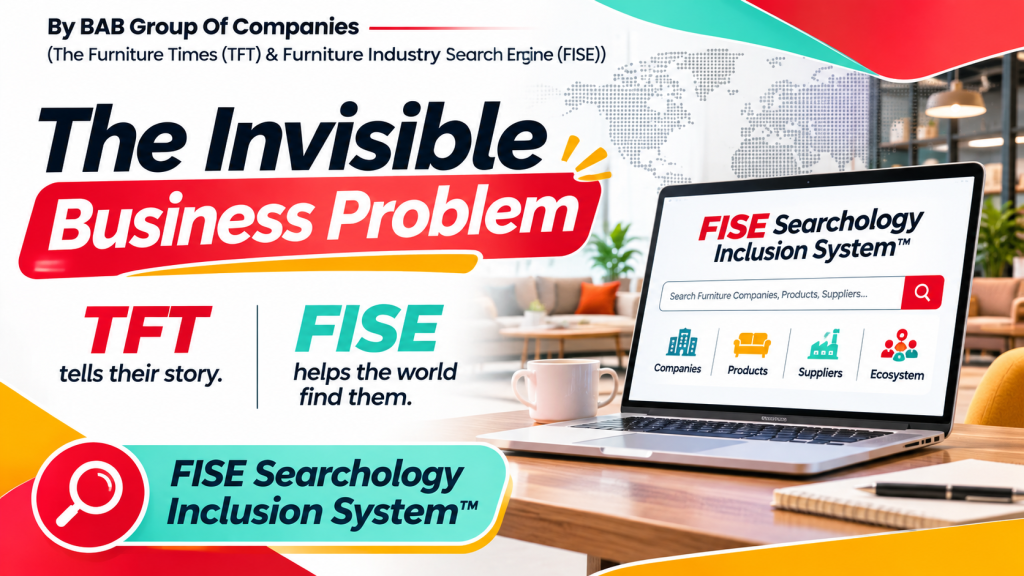
TFT tells their story.
The purpose of business storytelling goes beyond publishing promotional material. It creates an opportunity to communicate the people, ideas, experiences, products, and capabilities behind an enterprise.
For example, a furniture manufacturer can explain how its business began, what materials it works with, which product categories it specializes in, and what makes its approach distinctive.
An independent furniture designer can share the inspiration behind a collection.
An artisan can introduce the techniques and craftsmanship involved in creating handmade products.
An emerging company can communicate its mission, innovations, and ambitions.
These stories help audiences understand the businesses behind the products.
They can also support credibility and brand recognition when presented accurately and consistently.
For smaller businesses, storytelling can be particularly valuable because it allows them to communicate more than price. It gives them an opportunity to explain experience, specialization, values, and the human effort behind their work.
A product may attract initial interest. A meaningful business story can help people understand why that product and the company behind it deserve consideration.
In a crowded marketplace, being understood is an important step toward being remembered.
FISE: Because Telling Your Story Is Not Enough If Nobody Can Find It
Imagine publishing an excellent business story and then discovering that the people who could benefit from it never encounter it.
This is where the second part of the visibility challenge emerges.
Businesses need more than exposure. They need discoverability.
The Furniture Industry Search Engine (FISE) represents the discovery dimension of the BAB Group of Companies vision.
Its guiding principle is:
FISE helps the world find them.
While TFT focuses on business storytelling, FISE focuses on helping relevant audiences discover businesses within the furniture industry ecosystem.
Consider the different people who search for furniture-related businesses every day.
A retailer may be looking for manufacturers. An interior designer may need a specialized supplier. A hotel operator may be searching for furniture suitable for hospitality projects. An importer may want to identify potential manufacturing partners.
A furniture business with relevant information and a clear digital identity has a better opportunity to enter these discovery journeys.
FISE’s vision is to support a more connected environment where businesses can present their identities and capabilities and where people searching for relevant industry participants have a clearer starting point.
This is particularly important for smaller manufacturers, suppliers, independent designers, workshops, and artisans that may not have extensive international marketing resources.
A discovery-focused platform can help organize business information and make it easier for people to identify potentially relevant companies.
It is important to understand that being listed or discoverable does not automatically guarantee top search rankings, customer enquiries, contracts, or sales. Those outcomes depend on many factors, including relevance, competition, demand, information quality, and business execution.
But improving discoverability is an important part of reducing the distance between businesses and potential opportunities.
A business should not have to depend on someone accidentally finding it.
It should work toward building a digital presence that makes intentional discovery easier.
FISE LIVE: Moving Beyond Passive Online Presence
The internet has changed how people evaluate businesses.
A static page containing a company name and contact number may provide basic information, but today’s audiences increasingly want context. They want to understand products, capabilities, services, business identity, and the people behind an organization.
FISE LIVE forms part of the broader FISE ecosystem and its vision for a more connected digital business environment.
The opportunity behind this approach is to encourage greater interaction and engagement around business discovery.
For a manufacturer, a stronger digital presentation can help communicate product capabilities and support conversations with prospective buyers.
For an artisan, it can provide another opportunity to introduce work and craftsmanship.
For an SME, it can contribute to a more complete business identity and help potential audiences understand its offerings.
For industry participants, a connected ecosystem can create additional opportunities to explore businesses and identify relevant relationships.
The future of business visibility should not be limited to uploading information and hoping somebody sees it.
It should encourage useful connections between businesses and the people looking for their products, services, and capabilities.
The real measure of FISE LIVE will be the relevance, accessibility, engagement, and value it delivers to its participants.
FISE Searchology Inclusion System™: Addressing the Invisible Business Problem at Its Roots
This is where the wider vision becomes especially important.
The FISE Searchology Inclusion System™ is positioned as a global visibility engine for SMEs, artisans, makers, and grassroots creators.
It is built around a fundamental belief: valuable businesses and creators should have better opportunities to become discoverable, regardless of their size or marketing resources.
The invisible business problem is not experienced equally.
Large corporations often have established brand recognition. Smaller enterprises may be trying to establish their first meaningful digital identity.
Recognized manufacturers may already have relationships with international buyers. Independent workshops may be waiting for their first opportunity to reach a wider market.
Established designers may have extensive portfolios. Grassroots creators may still be trying to communicate what they make and why it matters.
The FISE Searchology Inclusion System™ places these overlooked participants at the centre of a broader digital inclusion vision.
It is not simply about creating another place to publish business names.
It represents five connected ambitions.
1. A livelihood system
Every small business represents more than a commercial operation.
It may support a family, provide employment, preserve specialized skills, or sustain a local community.
An artisan’s workshop may be the source of income for several people. A small furniture manufacturer may provide jobs to skilled workers. A local maker may depend on consistent demand to continue producing handmade goods.
When businesses become easier to discover, they may gain access to additional audiences and potential commercial relationships.
This creates an important connection between digital visibility and livelihoods.
The objective is to support better conditions for opportunity, not to promise guaranteed income.
A business still needs quality products, reliable operations, competitive pricing, and customer trust. But discoverability can help put that business in front of people who may be interested in what it offers.
The purpose of visibility should extend beyond attention. It should help create meaningful opportunities for people to build sustainable businesses.
2. A human impact system
Technology is often measured through data, performance, traffic, and platform activity.
But what happens to the people behind the numbers?
A small manufacturer gaining a new business enquiry is a human outcome. An artisan receiving recognition for years of craftsmanship is a human outcome. A grassroots creator finding an audience for an innovative product is a human outcome.
Digital inclusion becomes more meaningful when it recognizes these people and their aspirations.
The human impact dimension emphasizes that business visibility should not be viewed only as a marketing metric.
It should also be understood as a way of connecting people, skills, products, and opportunities.
The goal is to create an ecosystem in which smaller participants have a better chance of being seen and considered.
3. A search revolution
Search is one of the most important ways people navigate the modern digital economy.
Customers search for products. Businesses search for suppliers. Investors search for opportunities. Retailers search for manufacturers. Professionals search for partners.
Yet business information is often scattered across different websites, social networks, catalogues, and disconnected directories.
A more organized discovery environment can help make relevant business information easier to locate and understand.
For the furniture industry, this could involve clearer information about manufacturers, materials, product categories, suppliers, designers, and business capabilities.
For SMEs, it means recognizing that search visibility is not merely about appearing in search results. It is also about presenting useful, accurate, and relevant information.
A search revolution should improve the quality of discovery, not simply increase the number of listings.
4. A digital identity movement
A business without a clear digital identity can be difficult to evaluate.
Imagine a potential buyer discovering a company but finding no detailed product information, inconsistent contact details, outdated descriptions, or unclear business capabilities.
Would that buyer feel confident enough to initiate contact?
Digital identity helps answer fundamental questions.
Who are you? What do you offer? What makes your business different? What products or services do you specialize in? How can people contact you?
For an SME, this identity may include a business profile, website, product catalogue, professional images, company description, and accurate contact information.
For an artisan, it may include a portfolio, craftsmanship details, materials, and the story behind the work.
For a manufacturer, it may include production capabilities, product categories, certifications where applicable, and service information.
The FISE Searchology Inclusion System™ vision recognizes digital identity as an important foundation for discoverability.
Because before the world can understand your value, it needs to understand who you are.
5. A global opportunity engine
A local business may have products that appeal to international customers.
A small manufacturer may have production capabilities relevant to overseas retailers.
An artisan may create work that attracts interest from buyers in different countries.
But geographical distance can make these opportunities difficult to pursue.
A stronger digital presence can help businesses introduce themselves to audiences beyond their immediate communities.
The global opportunity engine vision is about making discovery more inclusive and supporting the possibility of connections across markets.
It does not suggest that every business will automatically become international. Export readiness, regulatory requirements, logistics, pricing, quality standards, and market demand remain essential.
However, businesses should have opportunities to present their capabilities and be considered by relevant audiences.
A business should not be limited to the market that happens to know it today.
Why the Furniture Industry Needs Better Business Discovery
The furniture industry is a complex global ecosystem.
It includes manufacturers, wholesalers, retailers, designers, carpenters, material suppliers, component producers, exporters, importers, distributors, interior specialists, and independent makers.
Each group has a different role, but all depend on connections.
A furniture retailer needs suppliers who can deliver the right products. A manufacturer needs buyers who understand its production capabilities. A designer needs access to materials and skilled production partners. An importer needs reliable manufacturers and clear business information.
When these participants cannot easily discover one another, the industry loses opportunities for potential collaboration.
The problem becomes even more significant for small businesses.
A large furniture brand may already have established distribution networks and international relationships. A smaller workshop may produce equally interesting products but lack access to the same commercial networks.
A discovery-focused furniture ecosystem can help address part of this challenge by making business information easier to organize and explore.
This is the broader relevance of FISE.
It is not simply about finding furniture products. It is about helping people discover the businesses, capabilities, and industry participants behind those products.
The Cost of Waiting: Why Businesses Must Take Visibility Seriously Now
Many businesses postpone digital development because they are busy.
They plan to improve their website later. They intend to organize their product photographs next month. They want to publish more content when operations become less demanding.
But the market does not stop moving while a business waits.
Customers continue searching. Competitors continue publishing. New businesses establish digital identities. Buyers continue evaluating suppliers.
Every day, potential customers make decisions based on the information they can access.
If your business information is incomplete, they may struggle to understand what you offer.
If your products are poorly presented, they may move on to another supplier.
If your contact information is outdated, an interested customer may be unable to reach you.
If your business has no clear digital identity, it may not enter the consideration process at all.
The urgency is not about chasing every new platform or digital trend.
It is about recognizing that discoverability has become an important part of modern business development.
Waiting until sales decline to address visibility may mean solving the problem later than necessary.
The right time to improve your business information is before a valuable opportunity appears.
How to Make Your Business More Discoverable: A Practical Action Plan
Recognizing the invisible business problem is only the beginning. Businesses must take practical steps to address it.
Here are seven actions that can strengthen digital discoverability.
Step 1: Build a clear business identity
Start with the fundamentals.
Ensure that your business name, contact details, location, website, and company description are accurate and consistent.
Explain what your business does in straightforward language.
Do not assume that potential customers already understand your products or services.
Step 2: Present your products professionally
Product information is essential, particularly for furniture businesses.
Use clear photographs, descriptive titles, accurate specifications, and relevant product categories.
Explain the materials, dimensions, applications, customization options, and other details that help buyers evaluate suitability.
Avoid vague descriptions that make different products appear identical.
Step 3: Communicate your business capabilities
Do not simply say that you manufacture furniture.
Explain what you manufacture, which markets you serve, your production capabilities, and the types of projects you can consider.
The same principle applies to artisans, designers, suppliers, and service providers.
Specific information makes it easier for relevant audiences to understand your business.
Step 4: Tell your story
Your business story can communicate experience, purpose, expertise, and differentiation.
Explain how the business began, what motivates the team, what makes its products distinctive, and what problems it solves.
This is where platforms focused on business storytelling, such as The Furniture Times, become relevant to the broader visibility conversation.
Step 5: Strengthen your search presence
Use clear website headings, descriptive page titles, relevant keywords, useful content, and structured business information.
Publish content that answers the questions potential customers actually ask.
For example:
- Where can retailers find reliable furniture manufacturers?
- What should buyers consider when selecting a furniture supplier?
- Which materials are suitable for outdoor furniture?
- How can furniture businesses identify international buyers?
- What should an importer know before approaching a manufacturer?
Useful content can help businesses attract relevant audiences while demonstrating their knowledge.
Step 6: Explore relevant discovery opportunities
Do not rely exclusively on one social media account or a single marketing channel.
Consider relevant industry platforms, business discovery environments, trade networks, professional communities, and opportunities to present your company to targeted audiences.
Explore the BAB Group of Companies ecosystem, including TFT, FISE, FISE LIVE, and the FISE Searchology Inclusion System™, to understand the available participation opportunities.
Step 7: Turn visibility into enquiries
Make the next step obvious.
Include clear contact details and calls to action.
Give prospective customers an easy way to request quotations, discuss products, explore catalogues, or initiate business conversations.
Respond professionally and promptly.
Track enquiries and identify which discovery channels generate relevant business opportunities.
Remember: traffic is not the same as revenue. The goal is to attract the right audience and make it easier for that audience to take meaningful action.
What Makes the BAB Group of Companies Vision Different?
The invisible business problem requires more than another conversation about marketing.
It requires a broader approach to how businesses communicate their identity, share their stories, and become discoverable.
The BAB Group of Companies vision connects several complementary dimensions.
The Furniture Times (TFT): The storytelling dimension.
TFT tells their story by giving attention to businesses, people, industry developments, ideas, and achievements within the furniture ecosystem.
Furniture Industry Search Engine (FISE): The discovery dimension.
FISE helps the world find them by focusing on business discoverability and the organization of relevant industry information.
FISE LIVE: The connected engagement dimension.
FISE LIVE contributes to the broader vision of a more interactive and connected digital business environment.
FISE Searchology Inclusion System™: The inclusion dimension.
This global visibility engine vision focuses on SMEs, artisans, makers, and grassroots creators who need better opportunities to establish digital identities and become discoverable.
Together, these elements communicate a broader ambition.
The objective is not simply to put more businesses online. It is to help make their information meaningful, their stories accessible, and their identities easier to discover.
This is a vision that connects technology with entrepreneurship and digital infrastructure with human opportunity.
The Bigger Question: How Many Valuable Businesses Are Still Waiting to Be Discovered?
Somewhere, a furniture manufacturer is producing products that could interest a new retailer.
Somewhere, an artisan is preserving a skill that deserves greater recognition.
Somewhere, a small enterprise is developing an innovative solution but struggling to reach its intended market.
Somewhere, a grassroots creator is building something meaningful without the resources to compete for digital attention.
These businesses are not necessarily lacking ambition, ability, or value.
They may simply be missing the visibility that helps opportunities find them.
The invisible business problem is therefore not just a challenge for individual companies. It is a broader issue for an economy that depends on the participation of businesses of different sizes.
A truly inclusive digital environment should recognize that innovation does not come exclusively from major corporations. Valuable ideas can emerge from independent workshops, small manufacturing units, local communities, family businesses, and individual creators.
Their contributions matter.
Their stories matter.
Their ability to participate in the digital economy matters.
This is why the conversation about business visibility must move beyond followers, likes, advertising impressions, and website traffic.
It must also consider who gets discovered, who gets considered, and who gets the opportunity to participate.
Final Thought: Do Not Let Your Business Become the Best-Kept Secret in Your Industry
You may have the experience. You may have the products. You may have the people, the skills, and the ambition.
But if the right audience cannot find your business, your potential remains harder to realize.
The invisible business problem is a warning for every entrepreneur who believes that good work alone will always attract attention.
In a competitive digital economy, businesses must make their value visible.
They must build recognizable identities, communicate their capabilities, share their stories, and create pathways for meaningful discovery.
Through The Furniture Times (TFT), Furniture Industry Search Engine (FISE), FISE LIVE, and the FISE Searchology Inclusion System™, BAB Group of Companies presents a vision of a more connected and inclusive approach to business visibility.
TFT tells their story.
FISE helps the world find them.
FISE LIVE expands the connected ecosystem.
The FISE Searchology Inclusion System™ places SMEs, artisans, makers, and grassroots creators at the heart of a global visibility vision.
And behind all these ambitions is one important belief: valuable businesses should have a better opportunity to be discovered, regardless of their size.
The next customer may be searching today. The next business partner may be looking for a supplier right now. The next opportunity may already exist in a market your business has not yet reached.
Do not wait until another competitor gets discovered first.
Do not allow years of hard work to remain hidden behind an incomplete digital identity.
Start improving how your business presents itself. Make your information accessible. Tell your story. Explore relevant discovery opportunities. Build a presence that helps the right people understand what you offer.
Because the greatest business opportunity you are missing may not be the one you rejected. It may be the one that never found you.
The invisible business problem is real. Making businesses discoverable is the opportunity.
BAB Group of Companies — Building a more connected future for business storytelling, digital discovery, and global visibility.